


Dawn’s Research Mission Extended
- Jordan Raccuia

- Jan 7, 2018
- 2 min read
In March 2015, NASA placed a spacecraft called Dawn into the orbit of the dwarf planet, Ceres. A dwarf planet is any object that resembles a planet, but does not follow all of the rules to classify it as one. Many objects in our solar system, including Pluto and Ceres, are considered dwarf planets. When first discovered, Ceres was believed to be a very large asteroid, located in the asteroid belt, which lies between Mars and Jupiter. Several hundred years of research later, astronomers decided to instead classify it as a dwarf planet, as it is much larger than the surrounding objects. Like the other inner planets, Ceres has a rocky core, but it also has a very thin atmosphere that may contain water vapor. With water vapor present, there is reason to believe that Ceres could contain life. Because of this, scientists want to study it and see what other characteristics of it that they can discover.
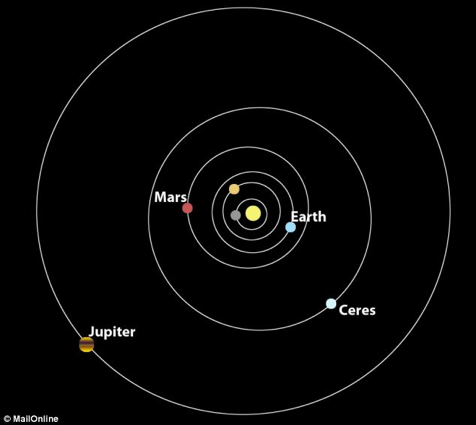
Photo Above: Diagram of Ceres’s Location in the Solar system. (Not to Scale)
Image source: The Daily Mail
After much research, it became important to find out more information about Ceres. In 2007, astronomers launched the spacecraft Dawn, to reach Ceres in order to gather more information about its surface. Eight years later, Dawn reached the dwarf planet and began its orbit. It has been gathering data for two years now, but scientists still want to see what else they can discover. To do that, NASA authorized an extension of the mission that will maneuver Dawn into a new orbit that is much closer to the surface of the dwarf planet. The new mission will use Dawn’s gamma ray and neutron spectrometer, which measures the amount of gamma rays and neutrons in Ceres’s surface, and will allow scientists to collect data that will help them learn more about the composition of Ceres. It also contains a camera that will gather more photos of its surface. Additionally, in April 2018, Ceres will be in perihelion, which is the point in its orbit where it lies closest to the Sun. This will cause more of the ice on its surface to melt and allow scientists to study its atmosphere more closely. It is estimated that Dawn will continue to gather information from Ceres until the second half of 2018, but even after it stops operating, it will remain in Ceres’s orbit forever.

Photo Above: Artist Rendition of the Dawn Spacecraft in Ceres’s atmosphere.
Image source: nasaspaceflight.com
Press Release: https://www.jpl.nasa.gov/news/news.php?release=2017-275
Additional Source: https://solarsystem.nasa.gov/planets/ceres/indepth

Comments